 Wiser by Day
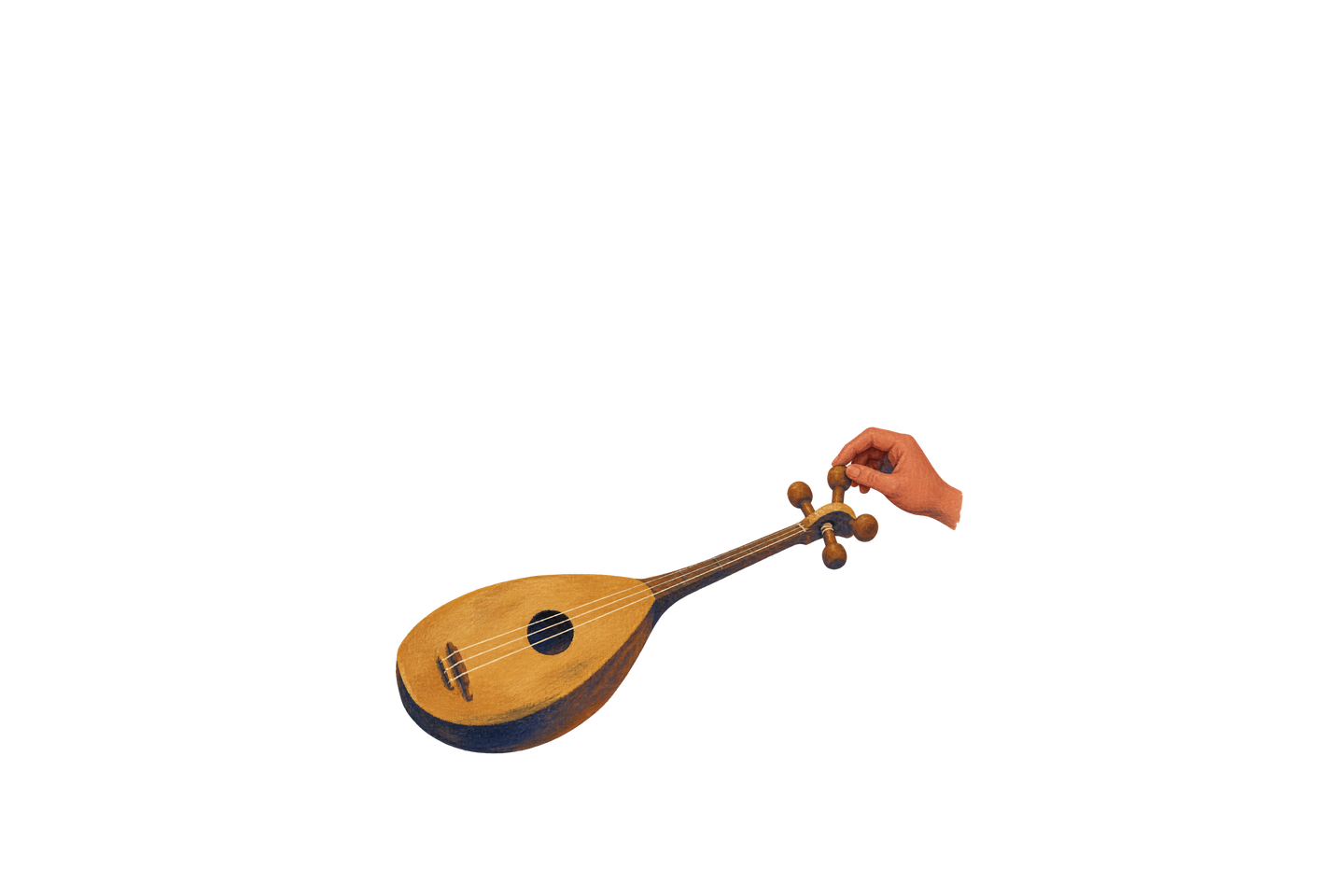
The answer is not another turn of the peg
You have spent an hour revising a paragraph. Each new version sounds less natural, so you make another change. You are working hard; that much is clear. Whether the extra effort is helping has become a different question.
This is our modern opening example, not the setting of the Buddhist story. It gives a small point of entry into a comparison about effort: sometimes the next useful action changes how you are working rather than adding another repetition of the same thing.
The musician’s answer
In AN 6.55, Sona is discouraged that persistent practice has not brought release and considers leaving the training. The Buddha asks about Sona’s earlier experience playing the vina. Strings made too tight or too loose are not playable; appropriate tuning makes the instrument usable.
The discourse applies this comparison to persistence, connecting excessive arousal with restlessness and slackness with laziness. Sona adjusts his practice; the narrative later describes his awakening. This is a brief paraphrase of Thanissaro Bhikkhu’s translation, not a report independently establishing the conversation or its events.
The text concerns Buddhist training and release, not a formula for efficient office work. Its outcome cannot be converted into a promise that a brief adjustment will bring the same result to a modern reader.
What the story supports, and what it leaves open
Textual evidence
AN 6.55 presents the tuning comparison within a conversation about persistence in practice.
Interpretation
Our writing example explores whether repeating an action is serving its purpose. It is a limited modern application.
Uncertainty and limits
The discourse does not specify a universal amount of effort or provide a historical reconstruction of the instrument. It does not justify ignoring a responsibility.
Change one condition you can examine
Return to the paragraph. You might need to leave it briefly and read it aloud, ask a reader which sentence is confusing, or check whether you have understood the point yourself. None of those options follows automatically from feeling tired. Choose one because you can explain what information it might provide.
If a reader identifies an unclear term, revising that term gives you a more definite task. If you discover that the paragraph has no single point, further polishing may be premature. Ask what the paragraph needs to do before deciding how much more time to spend on its wording.
Keep the example modest. Some work calls for sustained effort after the first discomfort. Other work cannot be repaired by individual persistence alone: the task may be unclear, the resources insufficient or the deadline unrealistic. Naming a condition you need to discuss can be more useful than judging your willingness to try.
Do not turn the image into an easy midpoint
A tuned instrument is not simply a compromise between two arbitrary settings. It has a purpose against which an adjustment can be judged. Likewise, doing half as much is not automatically wiser than doing twice as much. Ask what makes an action appropriate in this case.
Nor does the comparison make every difficulty a sign of excessive effort. Learning can be awkward. An unwelcome correction can still be useful. If you stop, distinguish a considered change in approach from avoiding the part of the task that needs attention. You may need another person’s judgment to see the difference.
Write down what would count as help
Choose one ordinary activity in which you keep increasing effort. Name its purpose, describe what you are currently doing and identify one sign that the method is helping. Avoid using time spent or discomfort endured as your only evidence.
Then try one change you can review: a clearer question, a smaller piece of the task, a conversation about a constraint or a deliberate break followed by a fresh attempt. Record what happened. This exercise cannot certify the right effort for every situation. It can make your next decision less dependent on the assumption that more of the same must be better.