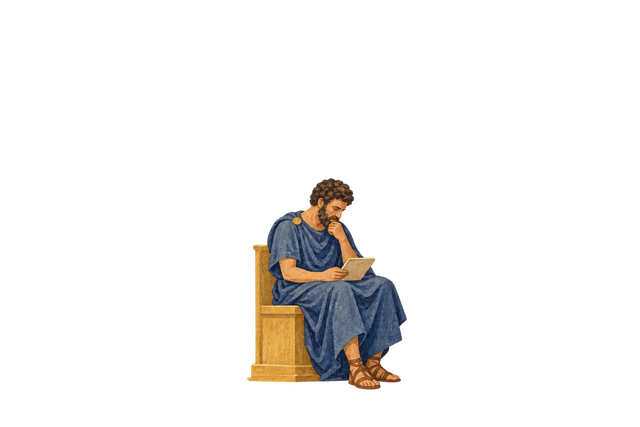
 Wiser by Day

A notebook is different from a finished argument
Meditations gathers Marcus Aurelius’s philosophical reminders in twelve books. It is commonly read as writing addressed to himself, rather than a systematic introduction prepared to teach a new student. Repetition is part of what you encounter: a concern returns in another image or another attempt to make it usable.
Marcus was Roman emperor from 161 to 180 CE. His position belongs in the reading, rather than outside it. A powerful person reminding himself to act justly gives us material to examine; it does not establish that every action of his rule met the standard. The Stanford Encyclopedia of Philosophy provides context for his life and the work’s Stoic aims.
Four short stops before reading straight through
The links below use George Long’s English translation. They open the relevant book; find the passage by its standard book-and-section number. The older English may slow you down, so read a small portion twice rather than collecting a large number of lines.
- 1.1 · What a person learned from others
Begin with the opening acknowledgment of his grandfather. Ask who has shaped one habit you value.
- 2.1 · Preparing to meet difficult people
Read the movement toward cooperation as well as the sharp descriptions. What response is he preparing himself to make?
- 5.1 · Getting up to do a human task
Notice the argument with reluctance. What is the work for, and what limits would your own circumstances add?
- 6.30 · A warning about the imperial role
Consider the danger of letting office shape character. How could a role you hold make correction harder to hear?
This route is our editorial suggestion, not a sequence prescribed by Marcus. It introduces gratitude, preparation, work and power without claiming those four passages summarise the whole book.
Turn a reminder into a question you can check
Suppose you read 2.1 before a meeting with someone whose manner you find difficult. Your first note is “Do not let them bother me.” That is an understandable wish, but it gives you little to observe except whether you feel bothered.
Try a more specific question: “Can I ask for the missing information before answering the tone?” You can check that against your words in the meeting. If the issue is repeated interruption, you might ask to finish your point. Cooperation can include an explicit limit.
Afterward, record what happened without improving the story. Perhaps you listened carefully once and then interrupted twice. That is more useful material than deciding that you were either perfectly Stoic or a complete failure. Return to the passage with a real question about the difficulty you met.
Keep the translator with the sentence
Different translations can use strikingly different language. Record a book-and-section reference as well as the translator. A quotation without those details is harder to check and easier to mistake for a modern paraphrase.
If one English phrase seems to settle a difficult question too neatly, compare the surrounding passage and, when available, another named edition. A polished line may be only part of an argument. The free Long version is a useful starting point; its vocabulary is not the only possible English rendering.
Our prompts about meetings and work are adaptations. Do not put them in quotation marks after Marcus’s name. Keeping source wording separate from your own question lets both remain useful.
Give the difficult material room to remain difficult
You will encounter claims about providence, nature, death, bodily life and other people that may be unfamiliar or unpersuasive. The book can sound severe. Read enough context to understand a claim before turning it into advice for someone else.
For example, a passage urging work does not establish how much rest an ill or exhausted person needs. Nor should language about judgment make a concrete injury disappear from view. A reader must consider what the ancient argument leaves out of a present situation.
Write “I do not agree yet” when that is the honest response. Disagreement gives you a reason to investigate the philosophy; it does not require abandoning every useful observation in the book.
A small reading practice
Choose one passage, not a page of highlights. Write its claim in your words, one ordinary situation where you could examine it and one reservation. Close the book and return to that situation when it arises.
In the evening, add a sentence about what you noticed. Maybe the passage helped you delay a reply; maybe the question was poorly chosen. Adjust the question before moving on. This modern reading exercise keeps the notebook from becoming another collection of impressive sentences you never meet in practice.