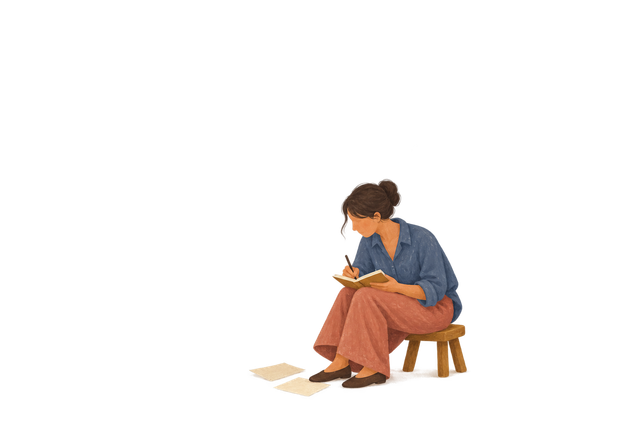
 Wiser by Day

Read with interest and an unanswered question
You recommend a calmer way to handle disagreement. Later, someone interrupts you and you snap at them. Your earlier advice may still be sound, but the incident leaves a useful question: what would it take to make that advice part of your conduct? It also gives the other person a reason to judge your actions alongside your words.
This modern example is one way into Seneca. Read him neither as a flawless model nor as a collection of sentences whose author never matters. His writing can sharpen a question even when his public life makes that question uncomfortable.
A short route through his public life
- 41 CE · Exile
- Seneca was exiled to Corsica. His life was exposed to imperial decisions, not conducted outside politics.
- 54 CE · Imperial adviser
- Already Nero’s tutor, he became an adviser after Nero’s accession.
- 65 CE · Death under Nero
- Accused of involvement in a conspiracy, he was compelled to take his own life.
Lucius Annaeus Seneca was born in Corduba, in what is now Spain, and educated in Rome. The Stanford Encyclopedia account linked below supplies the historical outline. His letters belong to his later years. They create a literary voice addressing Lucilius; they are not transparent diary entries. That distinction matters whenever an apparently intimate admission tempts us to reconstruct an entire private scene.
Two questions to carry into the letters
Begin with Letter 1, On Saving Time. Seneca asks Lucilius to attend to time that disappears, then admits in section 4 that he cannot claim to waste none himself. The admission makes the advice something to examine rather than a certificate of the writer’s perfection.
Next read Letter 6, On Sharing Knowledge, especially sections 5–6. He contrasts hearing instruction with observing a life. This is a demanding test to bring back to the author as well as to ourselves. Richard M. Gummere’s translation is linked for both letters.
Our practical questions are: what is this advice asking someone to notice, and what would count as evidence that it has affected their conduct? Keep these questions separate. An attractive instruction can be clear about the first while leaving the second unresolved.
Keep proximity to power in the picture
Nero’s adviser is not a neutral observer of imperial rule. That position belongs in a profile of Seneca alongside his moral teaching. You do not need to settle every dispute about his motives before reading a letter, but you should resist making his career disappear behind a reassuring quotation.
Nor does a contradiction automatically refute every argument an author makes. Examine the claim and the conduct on their own evidence, then ask how they bear on each other. If someone teaches careful speech while speaking carelessly, the lesson still needs reasons; the failure still calls for an account. Neither makes the other vanish.
This is a reading discipline, not a verdict that all compromise is equivalent or that every reader faces the dangers of an imperial court. Our small disagreements have different stakes. The historical distance should remain visible.
A manageable first reading
Read the whole of Letter 1 before choosing a sentence to save. Write a one-line account of the problem it addresses, then identify where the writer includes himself in it. Return the next day to Letter 6 and ask how watching a person act could change your view of their instruction.
For a modern application, choose one piece of advice you often give. Name one action this week through which another person could recognise it. “Listen better” might become letting a colleague finish and checking that you understood the request. This is an original exercise, not a timed method prescribed in either letter.
Finally, write one disagreement with what you read. A thoughtful reading need not end in admiration. It should leave you better able to say what the text proposes, where its reasons help and where its author or reader still has work to do.