 Wiser by Day
Begin with a question, not a collection of maxims
Someone can repeat a sentence about respect and still interrupt the person beside them. That gap between a saying and a response offers a useful entrance to Confucius. What kind of learning changes the way a person acts among others?
The name Confucius refers to Kongzi, Master Kong, a figure associated with teaching and questions of personal and political conduct. The familiar label can also conceal how differently later readers have understood him. Start with a passage and its setting rather than assuming that every proverb attached to his name belongs to him.
A cautious historical outline
- Traditionally 551–479 BCE
Conventional life dates, situated in the world of Lu and the declining Zhou political order. These dates do not make every later biographical episode secure.
- A teacher concerned with conduct
Transmitted sources portray learning, ritual, relationships and government as connected concerns, rather than separate self-improvement topics.
- A long textual afterlife
The Analects and other records preserve teachings and conversations through a complex history of collection and transmission.
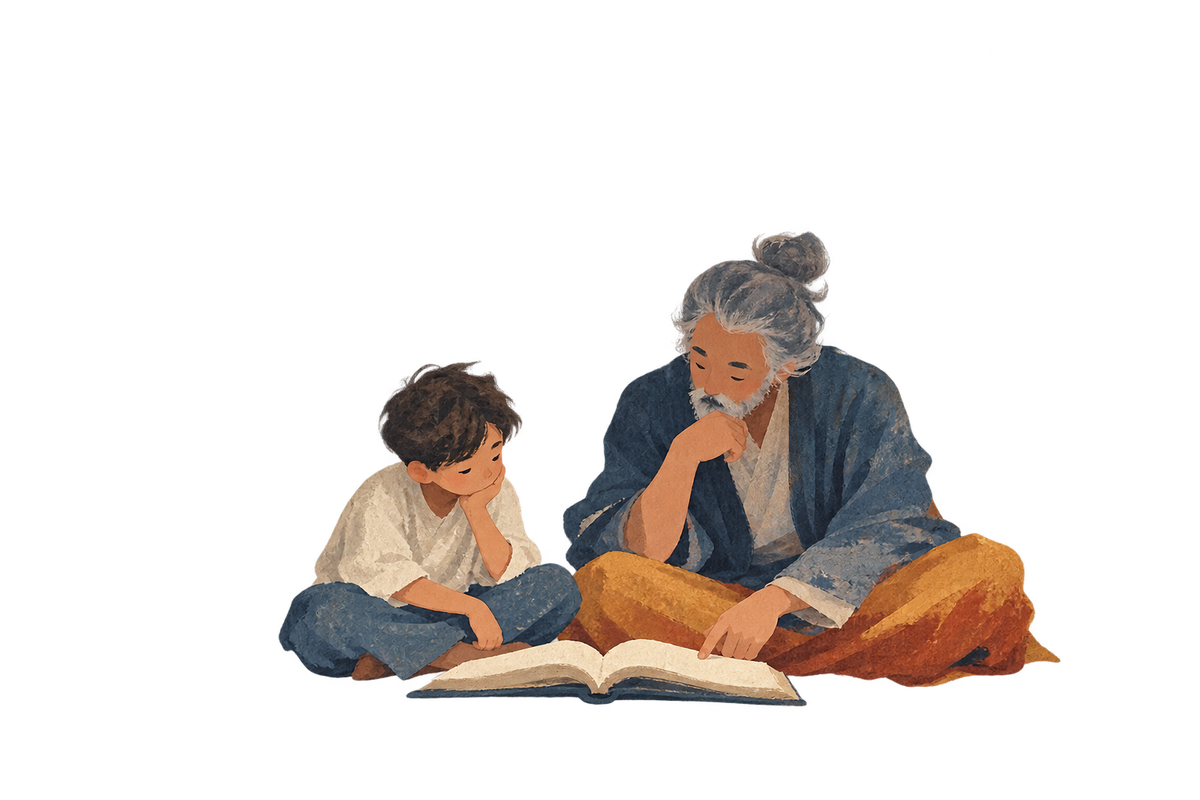
This outline follows the Stanford Encyclopedia of Philosophy’s source cautions. The illustration shows a contemporary learning relationship; it is not evidence of the teacher’s appearance or a reconstructed lesson.
What does learning ask you to do?
In Analects 2.17, the passage addressed to Yu links knowledge with acknowledging what one knows and does not know. Begin there when you feel pressure to give an answer larger than your evidence. The reading does not ask you to deny knowledge you possess.
Another entrance is 2.15, which brings learning and thought into relation. Read the short saying beside an actual task: what information have you gathered, and what have you done to examine it? Simply accumulating more material may leave your first assumption untouched.
These passages are not a modern theory of study methods. Our example is an application: prepare a question for the person who can explain the missing step, then see whether the explanation changes what you do. Naming a gap becomes useful when it helps learning continue.
Why ordinary forms matter
Ritual, often discussed through the term li, can sound like empty ceremony to a modern reader. A more useful initial question is how repeated forms shape attention. Does a greeting allow you to recognise the other person, or have you made it a noise you produce while looking elsewhere?
That greeting is our analogy, not a full translation of ritual propriety. The original setting includes social roles and inherited practices with implications far beyond politeness. Read those implications rather than silently replacing every unfamiliar term with a contemporary habit.
The distinction between form and attitude matters in Analects 3.3, which asks about ritual and music in relation to humane character. The passage gives you a reason to question the claim that correct outward performance is always sufficient.
Keep authority open to examination
A teaching concerned with roles and inherited forms can raise difficult questions. Which expectations cultivate responsibility, and which protect an unfair advantage? When someone invokes respect, what do they owe in return? You do not have to settle these questions before reading. Keep them beside the text.
Nor should you reduce Confucius to a spokesperson for obedience or turn him into a modern individualist. Both shortcuts can erase what makes the material challenging. Notice whose situation a saying addresses and whether your application changes that situation.
The historical record does not give us a single unproblematic voice behind every attributed conversation. That uncertainty calls for careful attribution, not a licence to attach a preferred message to the philosopher.
A small reading route
Read 2.17, then 2.15 and 3.3 in James Legge’s translation linked below. The older English and spellings may need patience. Record the book-and-section number with any note so that another translation remains easy to consult.
For each passage, write what it asks, what troubles you and one ordinary encounter it might illuminate. If the encounter seems to prove the saying immediately, look again for a detail that resists your reading. Let that detail become your next question.